Onset or increased intensity/frequency of headaches and migraines after having children

Onset or increased intensity/frequency of headaches and migraines after having children

Just had a baby? Life has changed with a new routine in place, one that is very repetitive yet unpredictable.

The emotions we feel after having a baby vary for everyone but are magnified and new to us. There is no right or wrong way to feel. Add to this the physical symptoms we are experiencing, and there is a lot to take in, let alone try to cope with head pain.

We know that the common underlying condition in headache and migraine is a sensitised brainstem. A sensitised brainstem means that your tolerance to normal events is reduced.

Why is the brainstem sensitised?

The brainstem receives information directly from the head as well as the upper cervical spine (top 3 structures in the neck). If there is a dysfunction present within the upper cervical spine, this will send noxious information into the brainstem, leading to the brainstem becoming sensitised.

Our posture leading up to giving birth is challenged by our center of gravity changing. Hormones, which relax the ligaments and soft tissue structures in the body, are not specific, so the structures at the top of the neck can be compromised.

The postures of new mums

When we are new mums, what postures do we find ourselves in? There is a LOT of sitting. We are recovering from the birth, and while we need to appreciate the healing process, which does involve a slower pace, this often involves sitting on a comfy seat with a slouched posture.

There is also a lot of looking down at our baby – baby snuggles are the best! They want and need us, but the position we are in does involve a lot of load to the top of the neck.

  • Feeding – breastfeeding and bottle-feeding generally involves sitting and looking down at the baby. In the early days, trying to latch the baby onto the breast is not always easy and involves a lot of sustained looking down.

  • Lifting and carrying – whenever we lift or carry something, we add load to our neck, especially when it is away from our body. Combine that with a forward head position, and this means we are adding a considerable load to the top of the neck.

Lifting the baby out of the cot or pram, carrying the baby capsule, and lifting the baby in and out of the car are some of the ways that can load the top of the neck.

So what can we do?

We appreciate that you will be in survival mode for the first few weeks and months. However, there are some things that can be done to decrease the stress and strain at the top of the neck and prevent the onset of head pain.

  • Sitting – try using the option of side-lying to assist in recovery and rest and take the load off our body and top of the neck. When we have to sit, ensure we sit tall and in a chair that supports us.

    Avoid furniture that encourages a slouched position. Use pillows or cushions, where needed, while we build the strength to maintain these positions.

  • Looking down at your baby – again, using the option of side-lying and snuggling, or sitting supported with the baby in a good position on your chest, so we are not in that sustained forward head posture, or sitting tall and nodding to look down at your baby.

  • Feeding – whether you are breastfeeding or bottle-feeding, it is important to ensure a good postural and head position.

  • Using the option of feeding in the side-lying position. Have your midwife or lactation consultant check your latch. Ensure you are supported with a pillow so that your head is in line with your spine, lower arm out in front, baby in line with your breast, and upper arm controlling their head while latching/feeding.

    Remember to relax your shoulders. With bottle-feeding, a similar concept applies. Ensure the correct position for baby while not compromising your own body position.

  • Feeding in sitting – sitting tall in a supportive chair that does not encourage a slouched posture. Use a feeding pillow(s) to ensure baby is at the correct height (if breastfeeding) and nod to look down while latching or feeding by bottle. Relax your shoulders.

  • Lifting and carrying – being mindful of your head position and head angle when leaning forward to place the baby in the cot or take them out. The goal is to maintain a neutral spinal position with the bend coming from your hips. Take a moment to reset your posture and head position before lifting. Hold the baby capsule with both arms close to your body rather than on one side.

It is important to try and avoid sitting in a slouched posture for any length of time, feeding the baby unsupported, leaning forward to bring the breast to the baby, and hanging your head forward when looking down.

Head pain from a musculoskeletal origin is not to be confused with pre-eclampsia headache or post-dural puncture headache – both of which are generally addressed when in the hospital or by your LMC.

If there is a dysfunction within the upper cervical spine, it is important to seek treatment and advice from a specialist in this area. Along with postural positioning, there are also exercises that can be done to help lower or eliminate head pain and build the strength required to help with desensitising the brainstem.

The team at The Headache Clinic are experts in this area and can tailor the correct treatment plan for you so you can get back to enjoying these precious days.
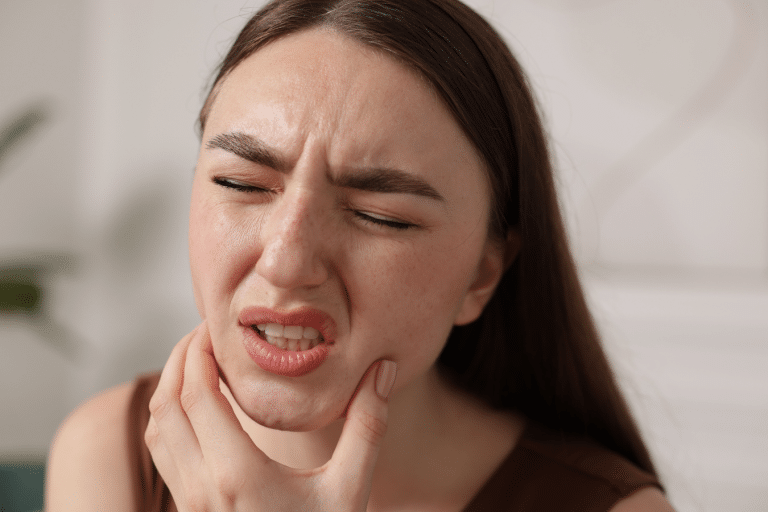

Jaw pain can affect far more than your jaw.

For many people, it shows up as a dull ache through the face, tightness around the temples, headaches, clicking when chewing, or a jaw that feels stiff or difficult to open. It may also come with teeth grinding at night, tension through the neck, or the sense that your jaw simply does not move the way it should.

These symptoms are often linked to TMD, also known as temporomandibular disorder. Many people call it “TMJ”, but that is actually the name of the joint itself. The temporomandibular joint, or TMJ, is the joint that connects your jaw to your skull. When that joint, and the muscles and nerves around it, are not functioning well, it can lead to ongoing pain and dysfunction.

At The Headache Clinic, we are experts in complex conditions involving the head, neck and jaw. That means we look deeper than the obvious symptom. If your jaw is painful, tight, clicking, locking, or contributing to headaches, we focus on finding the true driver of the problem and treating it with precision.

What is TMD?


Temporomandibular disorder (TMD) is a condition affecting the jaw joint and the muscles that control jaw movement. It can cause pain, stiffness, restricted movement, and a range of symptoms through the face, head and neck.

Because the jaw is used constantly for talking, chewing, swallowing and yawning, even mild dysfunction can become highly disruptive. For some people, symptoms come and go. For others, they become persistent and start to affect sleep, eating, concentration and quality of life.

Common symptoms of TMD:


TMD can present in different ways, but common symptoms include:

- Jaw pain or tenderness, often around the joint or muscles
- Clicking, popping, or grinding sounds with jaw movement
- Difficulty opening the mouth fully or reduced range
- Jaw locking, catching, or stiffness
- Pain when chewing, talking, or prolonged mouth use
- Facial pain or a sense of pressure
- Headaches, particularly through the temples
- Clenching or grinding of the teeth, especially at night
- Neck pain and increased muscular tension
- Pain around the ear or a feeling of tightness through the side of the face


In many cases, people do not initially realise their headaches or facial pain could be coming from the jaw.

Why does TMD happen?


TMD rarely has one single cause. More often, it develops because several factors combine over time and place ongoing strain on the jaw joint and surrounding muscles.

Common contributors include:

- Stress and tension
- Teeth clenching or grinding, also called bruxism
- Excessive gum chewing
- Previous jaw injury
- Joint irritation or arthritic change
- Muscle tension through the jaw, face and neck
- Poor coordination between the jaw and upper neck

This is why generic advice does not always work. A mouthguard may help protect the teeth. Resting the jaw may ease symptoms briefly. But if the underlying dysfunction is still there, the pain often returns.

Why jaw problems often trigger headaches


The jaw, head and upper neck are closely connected. When the jaw is not moving properly, the surrounding muscles often become tense and overworked. This can refer pain into the temples, cheeks, behind the eyes and into the head.

For some people, this creates a repeating cycle. The jaw becomes tight, headaches become more frequent, the neck stiffens, and clenching increases, especially during sleep or times of stress.

That is why effective treatment needs to look beyond the jaw alone.

Why TMD is often missed or poorly treated


TMD is common, yet it is often not treated in a truly specialised way.

Many people are told to avoid chewy foods, wear a splint, or do a few basic exercises. While those strategies can sometimes help, they may not resolve the deeper issue if the real problem involves joint restriction, muscle dysfunction, neural irritation, or an associated neck problem.

This is where a more skilled and targeted approach can make all the difference.

At The Headache Clinic, treating jaw disorders is not an afterthought. It is part of our niche with complex head, neck and facial conditions.

Our approach to TMJ and TMD treatment


We provide a expert hands-on physiotherapy approach for people experiencing jaw pain, clenching, grinding, restricted movement and jaw-related headaches.

Your treatment is tailored to the structures actually involved in your symptoms. Depending on your presentation, this may include:

- Targeted treatment to the jaw joint
- Hands-on therapy for the surrounding muscles
- Treatment of associated neck dysfunction
- Careful work around facial and neural tension
- Restoring normal jaw movement and control
- Reducing the cycle of stiffness, overactivity and clenching
- Our aim is not simply to help you cope.

Our goal is to improve how the jaw and surrounding system function, so you can get lasting relief and return to eating, speaking and moving comfortably.

Is clenching and grinding a sign of TMD?


It can be.

Clenching and grinding often place significant load on the jaw joint and the muscles around it. Over time, this can lead to soreness, restricted movement, facial tension, worn teeth and headaches, especially on waking.

For some people, clenching is the main driver. For others, it is part of a broader pattern involving the jaw, neck and nervous system. Either way, it is worth assessing properly rather than simply assuming a night guard will solve it.

When should you seek treatment for jaw pain?

ou should consider an assessment if you have:

- Persistent jaw pain or tightness
- Clicking or locking of the jaw
- Difficulty opening your mouth fully
- Pain when chewing
- Frequent headaches with facial or temple tension
- Teeth grinding or clenching at night
- Ongoing symptoms that are not improving

You do not need to wait until symptoms become severe. Early treatment can often prevent the problem becoming more entrenched.

Why patients choose The Headache Clinic


People come to us because they want more than temporary relief.

They want a clear explanation of what is going on, a clinician who understands the connection between the jaw, head and neck, and a treatment plan that is specific to them.

At The Headache Clinic, we combine clinical expertise with a careful, hands-on approach that is designed to uncover and address the true cause of your symptoms. For patients with TMD, that often means finally feeling understood after months or even years of frustration.

Book a TMJ assessment

If you are dealing with jaw pain, clicking, clenching, grinding, headaches or restricted jaw movement, we are here to help.

Book your assessment today and take the first step towards a more comfortable jaw, fewer headaches, and relief that lasts.

Onset or increased intensity/frequency of headaches and migraines after having children

about us
Expert headache, migraine and concussion care, focused on getting to the source of your symptoms for lasting relief.

© 2026 | The Headache Clinic | All Rights Reserved | Designed by